
Wondering how many blog posts you need before applying for Google AdSense? Discover the realistic number of articles, quality standards, and approval tips that actually improve your chances.
There is a stage every new blogger gets to — usually after publishing a few articles — where excitement starts mixing with impatience.
You’ve spent days, maybe weeks, building your website.
You bought hosting.
Installed a theme.
Customized menus.
Wrote what you believe are decent blog posts.
Then naturally, the next thought enters your mind:
“Can I apply for Google AdSense now?”
And almost immediately, the bigger question follows:
“How many blog posts do I actually need before Google will approve me?”
This is one of the most searched beginner monetization questions online, and for good reason.
Because AdSense rejection can be discouraging.
Very discouraging.
Especially when you feel like you’ve already done “enough,” only to receive a vague email saying your site is not ready, has low value content, or does not yet meet publisher standards.
At that point, most beginners start hunting for a magic number.
10 posts?
15 posts?
20 posts?
50 posts?
They want certainty.
They want someone to simply say:
“Once you hit this number, you’re safe.”
But here is the honest truth after watching countless beginner blogs get approved — and rejected:
Google AdSense does not approve websites based on article count alone.
Yet article count still matters far more than many people realize.
And if you apply too early with an underdeveloped blog, your chances drop significantly.
So in this guide, we’re going beyond random forum guesses.
I’m going to show you:
- the realistic number of blog posts most successful approvals have,
- why publishing only a few articles usually backfires,
- what kind of posts actually count,
- what Google is silently evaluating on your website,
- and when your site is truly mature enough to apply.
If your goal is to avoid unnecessary rejection and get approved faster, read this carefully before submitting anything.
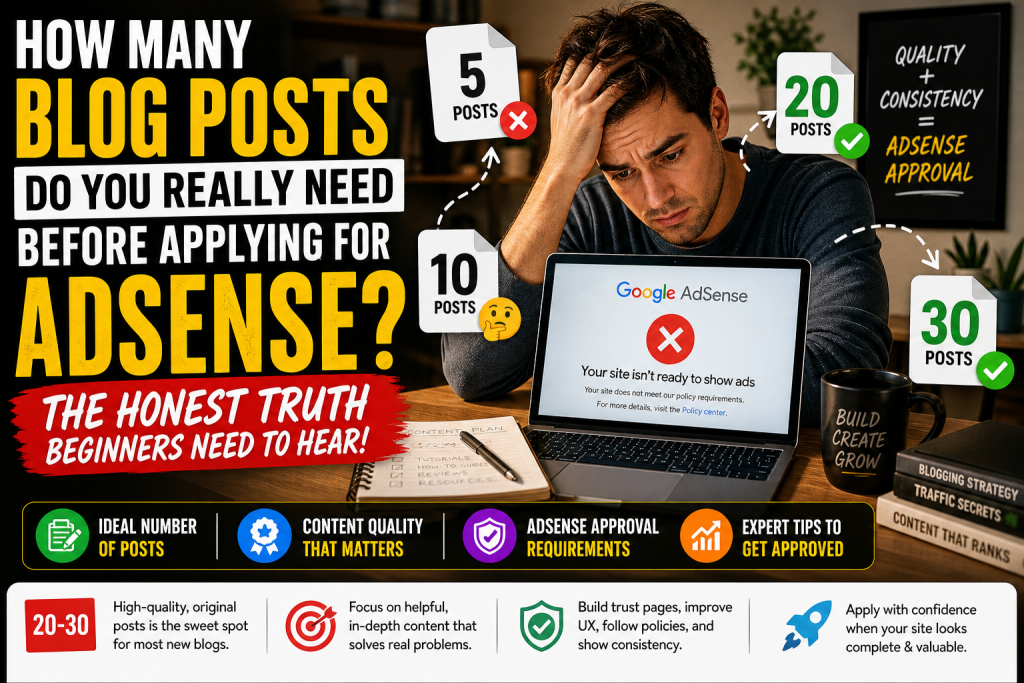
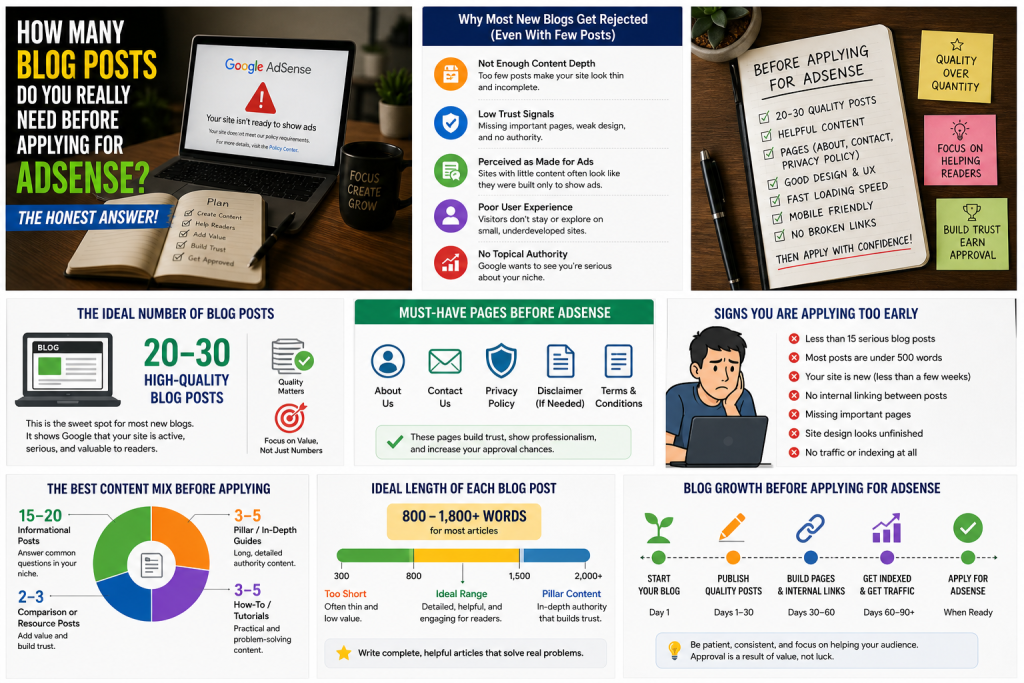
The Straight Answer: Most New Blogs Need 20 to 30 High-Quality Posts Before Applying
Let’s remove the suspense.
For the average beginner website, the safest and most practical range is:
20 to 30 quality blog posts.
That does not mean 20 rushed articles.
It does not mean 20 AI-generated pieces.
It does not mean 20 short 400-word posts written in one weekend.
It means 20 to 30 genuinely useful, original, niche-relevant articles that make your website feel complete.
This range is not an official number published by Google AdSense.
Google does not publicly announce a minimum article requirement.
But in the real world, after observing approval trends across thousands of bloggers, this range keeps appearing as the point where websites stop looking “new” and start looking “established.”
That distinction matters.
Because AdSense is not simply reviewing content.
They are reviewing whether your site appears worthy of hosting advertiser inventory.
And advertisers are Google’s paying customers.
Google has to protect them.
That means your blog needs to look like more than a side project with five lonely posts sitting on it.
Why 5 to 10 Blog Posts Usually Isn’t Enough (Even If They’re Good)
This is where many beginners miscalculate.
They think:
“My articles are well written, so why wait?”
Because from Google’s perspective, a small blog still creates multiple trust problems.
A website with only a handful of articles often signals:
- the site is still under construction,
- the publisher may not be consistent,
- there is not enough topical authority yet,
- user navigation feels shallow,
- and the website may have been created primarily for monetization.
That last point is important.
Google has spent years fighting thin “made for AdSense” websites — sites built only to show ads without delivering meaningful reader value.
So when reviewers land on a blog with:
- 6 articles,
- incomplete categories,
- basic pages,
- little content depth,
it can trigger caution immediately.
Even if those six articles are not bad.
The issue is perception.
The site does not yet feel like a real publication.
It feels like a starter shell.
And AdSense reviewers are trained to detect that difference quickly.
The Mistake Most Bloggers Make: They Obsess Over Quantity and Ignore Site Maturity
Let me be blunt:
You can publish 40 weak articles and still get rejected.
This happens every day.
Why?
Because bloggers hear “publish more posts” and start pumping out content mechanically.
They write:
- shallow keyword summaries,
- repetitive listicles,
- spun competitor posts,
- AI paragraphs with no personality,
- articles that answer nothing in depth.
On paper, they have numbers.
But in practical quality, the website still looks empty.
Google’s approval process is much more holistic than many beginners think.
Their systems look at signals like:
- originality,
- usefulness,
- content depth,
- expertise indicators,
- reader satisfaction,
- site trust,
- navigation experience,
- and whether your content actually helps humans.
So yes — article count matters.
But article count only helps when each post contributes to the feeling that:
“This website exists to serve readers, not just to earn ad clicks.”
That subtle distinction is often the line between approval and rejection.
Think Like Google: What Is AdSense Actually Trying to Protect?
Most people think AdSense approval is just a technical checklist.
It’s not.
It is a risk evaluation.
Google is asking one major question:
“Is this a site we are comfortable sending advertisers to?”
That includes several silent considerations.
Will users trust this website?
If the blog looks unfinished, sparse, or generic, user trust is low.
Will users stay long enough to interact meaningfully?
Thin sites usually have poor page depth.
Does the publisher appear serious?
Consistency matters.
Is the content safe, original, and useful?
Advertisers do not want their ads on junk pages.
Is this likely to become a stable publisher account?
Google prefers publishers who look sustainable.
This is why applying with too few posts can fail even when you technically violated no policy.
Your website simply has not built enough confidence yet.
So What Kind of Blog Posts Should Those 20–30 Articles Be?
This is where strategy matters.
Not all published pages contribute equally.
Some bloggers have 25 posts but only 8 of them are truly valuable.
That weakens the whole domain.
Before applying, your content should include articles that actually solve user intent.
Best-performing AdSense-ready content usually falls into these categories:
1. Problem-solving how-to posts
Articles that teach readers exactly how to do something.
2. Beginner educational guides
Explanatory content that answers common questions in your niche.
3. Detailed troubleshooting posts
Fix-it style content performs very well because it demonstrates utility.
4. Comparison/resource articles
Useful recommendation or distinction articles.
5. Foundational pillar guides
Long authority pieces that make your blog feel substantial.
These are the types of posts that make reviewers see usefulness instead of filler.
How Long Should Each Article Be Before Applying?
This question matters because article length often reveals article seriousness.
Can short posts rank?
Yes.
Can short posts get AdSense approval?
Sometimes.
But a blog filled with 300-word snippets often looks thin.
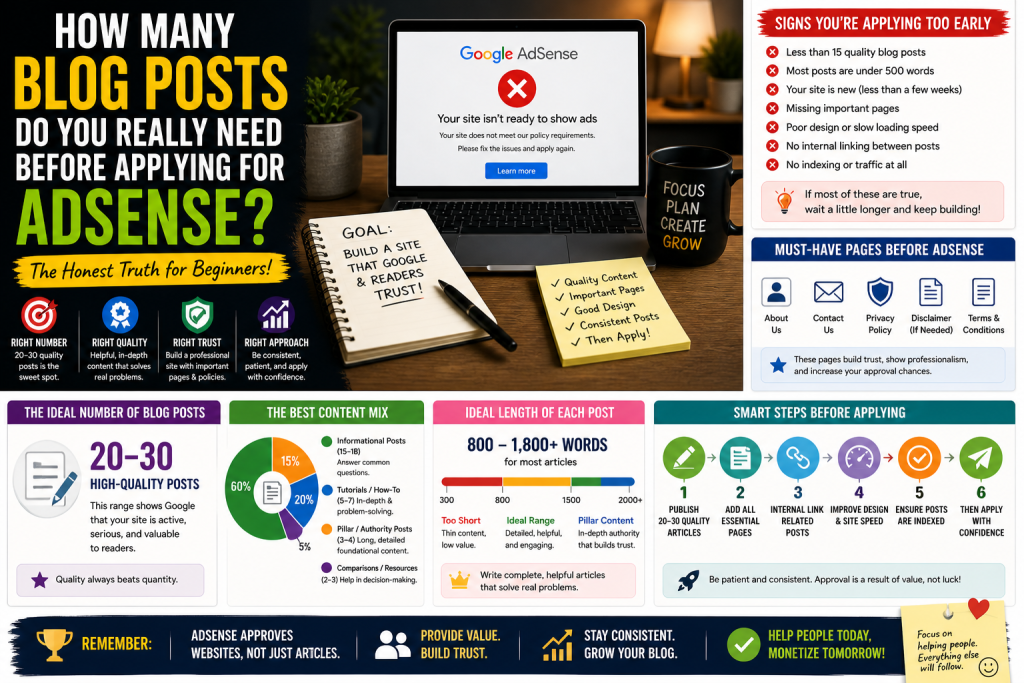
A much safer benchmark is:
800 to 1,800 words for standard articles
and
2,000+ words for major pillar posts.
Why this works:
Longer content naturally creates:
- fuller answers,
- stronger keyword coverage,
- more semantic depth,
- better internal linking opportunities,
- more user engagement.
You do not need to artificially stretch sentences.
Readers can smell padding.
But every article should feel complete enough that someone leaves with a resolved question.
If the page feels like a teaser instead of an answer, it weakens your approval profile.
Content Depth Matters More Than Bloggers Realize
Here’s something many new publishers learn too late:
Google is not just counting URLs.
They are judging whether your website demonstrates topical commitment.
For example:
A tech blog with 25 articles all about:
- website setup,
- blogging errors,
- WordPress fixes,
- monetization tutorials,
- plugin recommendations,
looks focused.
A random blog with 25 unrelated posts on:
- health,
- celebrity gossip,
- insurance,
- recipes,
- motivation,
- crypto,
looks unfocused and suspicious.
Niche coherence creates trust.
It tells Google:
this publisher knows what they are writing about.
So before applying, your posts should not just be many.
They should collectively make sense.
The Ideal AdSense Pre-Approval Content Structure (This Works Better Than Random Posting)
Here is a much smarter way to build those first 30 articles:
15 to 18 low-competition informational search posts
Target simple user questions.
5 to 7 medium-depth tutorials
Demonstrate practical expertise.
3 to 4 long pillar authority articles
Your strongest evergreen guides.
2 to 3 comparison/resource pieces
Helpful monetizable support content.
This creates a natural content ecosystem.
When a reviewer clicks around, they see substance.
Not isolated orphan articles.
Your Blog Needs More Than Posts — This Is Where Many Rejections Come From
A lot of beginners think:
“I have enough articles now, I’m ready.”
Then they get rejected because the site still feels incomplete.
AdSense reviewers also check the professionalism of your website.
You should have:
- About page
- Contact page
- Privacy policy
- Terms/disclaimer where needed
- clear navigation menu
- category structure
- mobile responsive design
- decent loading speed
- no broken demo pages
- no placeholder text
- no spammy popups
This all contributes to publisher legitimacy.
A blog with 30 articles but sloppy trust infrastructure can still fail.
How to Know You Are Applying Too Early (Most Beginners Ignore These Signs)
Be honest with yourself.
You are probably applying too early if:
- your homepage still looks empty,
- sidebar widgets are unfinished,
- categories have one post each,
- several articles are thin,
- internal linking is poor,
- there is little search indexing,
- the site is only a couple of weeks old,
- you personally still feel the blog is “not quite there.”
That instinct is usually correct.
If your own website still feels young to you, it will likely feel young to Google too.
Can You Get Approved With Less Than 20 Posts? Yes — But It’s the Exception, Not the Rule
There are always bloggers online saying:
“I got approved with 12 posts.”
Yes, that happens.
But usually one of these is true:
- the niche was exceptionally clean,
- the content was extremely detailed,
- the site design looked premium,
- the domain had some age,
- or traffic/user trust signals were already decent.
Beginners often hear these rare success stories and use them as a shortcut.
That is dangerous.
Building your plan around exceptions is how unnecessary rejections happen.
The average new blogger should optimize for probability, not luck.
And probability favors a fuller content base.
The Smartest Beginner Strategy Before Clicking Apply
Do this instead of rushing:
Publish until the website feels undeniably useful.
Not barely ready.
Not technically enough.
Undeniably useful.
That usually means:
- 20–30 strong articles,
- visible niche depth,
- complete trust pages,
- polished navigation,
- indexed content,
- internal links,
- no thin junk.
Then review your site as if you were a stranger.
Would this look like a website worth reading for an hour?
If yes, your approval chances rise dramatically.
If it still looks like a personal experiment, keep building.
A delayed application is far less costly than repeated rejection.
Final Verdict: Stop Chasing a Number and Start Building an Approval-Worthy Website
So how many blog posts do you really need before applying for AdSense?
The realistic safe answer is 20 to 30 high-quality, original, well-structured blog posts.
But the deeper truth is this:
Google is not approving numbers.
Google is approving confidence.
Confidence that:
- your website is useful,
- your publishing is serious,
- your niche has depth,
- and advertisers will be placed on pages that offer real value.
That confidence is hard to build with 5 posts.
Possible with 12.
Much stronger with 20 to 30.
Do not rush to monetize an unfinished house.
Finish building the house first.
Then invite AdSense in.
That simple patience changes outcomes more than most beginners realize.
FAQ
Is 10 blog posts enough for AdSense?
Usually no. While some sites get approved, 10 posts often make the website look too thin unless every article is highly detailed.
How many words should my AdSense articles have?
A healthy range is 800–1,800 words, with some long pillar articles above 2,000 words.
Does Google AdSense require traffic before approval?
Not necessarily huge traffic, but indexed pages and signs of real user usefulness help.
Can I apply for AdSense with AI-written content?
Only if the content is heavily human-edited, original, helpful, and not generic machine text.
How old should my blog be before AdSense?
There is no strict age rule, but a site that has been active for a few weeks to a few months generally appears more trustworthy than a brand new one.