Starting a software company used to sound like something that required a large development team, significant investment, expensive infrastructure and years of preparation.
Today, that picture has changed.
A single developer, designer, marketer or entrepreneur can build a small software product, put it online and charge customers a recurring subscription without building a massive company around it.
This is one reason the micro-SaaS business model has become increasingly attractive to independent founders and small teams.
The basic idea is surprisingly simple:
Find one specific problem that a particular group of people repeatedly experiences, build a small software product that solves it, and charge those people for the convenience and value it provides.
That sounds easier than building the next major social network or enterprise software platform because it is.
The goal of micro-SaaS is not necessarily to serve millions of users.
It is to serve a clearly defined group extremely well.
A micro-SaaS product could help photographers automatically deliver client galleries, help small restaurants manage reservations, help freelancers generate professional invoices, help online stores monitor a particular type of inventory problem, or help content creators perform one repetitive task faster.
The product may appear small.
The business opportunity does not have to be.
According to recent descriptions of the model, micro-SaaS generally focuses on a narrow audience, a tightly defined problem and a small team, often with a bootstrapped approach rather than venture-capital funding.
The most important lesson is that you do not have to solve every problem to build a successful software business.
Sometimes, solving one annoying problem extremely well is enough.

What Exactly Is a Micro-SaaS Business?
SaaS stands for Software as a Service.
Instead of selling software as a one-time product that customers install permanently on their computers, SaaS businesses generally provide access to software through the internet, often using a subscription model.
Micro-SaaS takes that model and makes it deliberately smaller and more focused.
A micro-SaaS business typically has:
- A narrow target audience
- One clearly defined problem
- A focused product
- A small development team
- Relatively low operating costs
- Recurring revenue
- A strong focus on profitability and sustainability
The “micro” does not necessarily mean that the software is insignificant.
It refers more to the scope of the business and product.
For example, imagine a developer notices that independent photographers spend hours manually sending clients reminders before scheduled photoshoots.
Instead of building a huge photography management platform containing websites, payment processing, editing tools, customer relationship management and accounting, the developer could build a tiny application that does one thing:
Automatically send personalized reminders to photography clients.
That could be a micro-SaaS.
The product solves a specific problem.
The target customer is clear.
The feature set is manageable.
The pricing can be simple.
And the founder does not need to build a 50-person company just to operate the product.
That focus is what makes the model attractive.
Why Solving One Small Problem Can Be Better Than Building a Huge App
One of the biggest mistakes new software entrepreneurs make is trying to build too much.
They think:
“If I want people to pay for my software, I need lots of features.”
Usually, the opposite is closer to the truth.
People do not pay simply because an application has 100 features.
They pay because the application solves a problem that matters to them.
Imagine two products.
Product A
A massive business platform with:
- CRM
- Accounting
- Email marketing
- Project management
- Payroll
- Inventory
- Website builder
- Social media scheduling
- Analytics
- AI assistant
- Customer support
- Team chat
It sounds impressive.
But a small business owner may only need one feature.
Product B
A simple application that automatically reminds customers about unpaid invoices.
It does only that.
But if a business owner loses hours every week chasing unpaid invoices, Product B could be more valuable to that person than Product A.
That is the fundamental idea behind micro-SaaS.
Do not ask, “What huge application can I build?”
Ask:
“What small, expensive, frustrating or repetitive problem can I remove?”
Step 1: Find a Problem Before You Build Anything
The first stage of starting a micro-SaaS business is not coding.
It is research.
Before opening your code editor, identify a problem.
Look at what people repeatedly complain about.
Pay attention to phrases such as:
- “I wish there was a tool that…”
- “This takes me hours every week.”
- “I have to do this manually.”
- “Why doesn’t this software support…”
- “I keep forgetting to…”
- “There has to be an easier way.”
- “I currently use a spreadsheet for this.”
- “This platform doesn’t integrate with…”
- “I have to copy this information from one system to another.”
These statements can reveal software opportunities.
A problem becomes particularly interesting when it is:
Frequent + frustrating + expensive + repetitive.
If someone experiences a problem once every three years, they probably will not pay much to solve it.
But if they experience it every day, the opportunity becomes much stronger.
Step 2: Look for Problems in Existing Workflows
One of the easiest ways to discover SaaS startup ideas is to observe how people already work.
You do not necessarily need to invent something completely new.
In fact, many good software businesses improve existing workflows.
Look at businesses around you.
How do they manage customers?
How do they create invoices?
How do they schedule appointments?
How do they collect information?
How do they generate reports?
How do they communicate with customers?
How do they move information from one application to another?
How do they track payments?
How do they monitor deadlines?
How do they create documents?
How do they handle repetitive administrative work?
You may discover that someone is spending five hours every week performing a task that could be automated.
That is potentially a micro-SaaS opportunity.
Step 3: Choose a Specific Customer
A common mistake is saying:
“My software is for everyone.”
That sounds like a large market, but it makes marketing extremely difficult.
Instead, become specific.
Instead of:
Software for businesses
Try:
Software for Nigerian Instagram-based fashion businesses to track customer orders.
Instead of:
Scheduling software
Try:
Appointment scheduling software for independent beauty professionals.
Instead of:
Invoice software
Try:
Invoice follow-up software for freelance designers.
Instead of:
Social media software
Try:
A tool that helps small restaurants turn their weekly menu into social media posts.
The narrower audience makes it easier to understand what the customer actually needs.
You can always expand later.
Starting narrow does not mean staying narrow forever.
Step 4: Validate the Problem
This is one of the most important steps in the entire process.
Do not assume that because you think an idea is useful, people will pay for it.
Ask potential customers.
Talk to them.
Observe them.
Find out how they currently solve the problem.
Suppose you want to build software that helps freelancers track invoices.
Do not immediately spend three months building it.
Talk to freelancers first.
Ask:
- How do you currently create invoices?
- How do you know which invoices are unpaid?
- How often do customers pay late?
- How do you follow up?
- What tools do you currently use?
- What is frustrating about your current process?
- Have you ever paid for software to solve this?
- What would make you switch?
The answers are much more valuable than random opinions.
The strongest validation often comes from people who already spend money or significant time trying to solve the problem.
Step 5: Find Out Whether People Will Pay
There is a major difference between:
“That’s a good idea.”
and
“I would pay for that.”
People are naturally polite when discussing ideas.
Someone may tell you your product sounds excellent and then never use it.
That is why you need stronger signals.
For example:
- Someone agrees to become a beta customer.
- Someone gives you their email for launch updates.
- Someone agrees to test your prototype.
- Someone asks when the product will be available.
- Someone offers to pay for early access.
- Someone explains exactly how the product would save them money or time.
These signals are much more meaningful.
Your objective is not to prove that everyone loves your idea.
Your objective is to find a small number of people who have the problem badly enough to care about a solution.
Step 6: Define Your Minimum Viable Product
Once the problem is validated, define the smallest version of your product that can solve it.
This is your MVP — Minimum Viable Product.
The MVP should not attempt to impress everyone.
It should solve the core problem.
Imagine your idea is an application that automatically reminds customers about appointments.
The MVP might only need:
- Customer information
- Appointment date
- Reminder message
- Automatic sending
- Basic dashboard
You probably do not need:
- Advanced analytics
- Ten dashboard themes
- A built-in CRM
- Team chat
- AI-generated reports
- A mobile application
- Twenty integrations
- Complex permission systems
Those features might eventually become useful.
But they are not necessary to prove the basic idea.
Step 7: Build the Simplest Useful Version
Your first product should be small enough to finish.
This is especially important for a bootstrapped startup.
A common problem among first-time founders is spending months building a sophisticated application before allowing customers to see it.
That creates enormous risk.
Instead, build something customers can use as quickly as reasonably possible.
The product does not have to be perfect.
It needs to be useful.
In today’s development environment, founders have access to traditional programming frameworks, cloud services, APIs, no-code platforms and AI-assisted development tools. These can reduce the amount of time required to create prototypes and initial products.
But faster development does not eliminate the need for product thinking.
It simply means that building is becoming less of the excuse for delaying validation.
The difficult question remains:
Are you building something people actually want?

Step 8: Keep Your Technology Stack Simple
A micro-SaaS business does not need an unnecessarily complicated technology stack.
Your goal is reliability, not technological bragging rights.
Depending on the product, your stack might contain:
- A frontend
- A backend
- A database
- Authentication
- Payment processing
- Email or messaging
- Hosting
- Analytics
That may be enough.
Avoid introducing technologies simply because they are popular.
Every additional service can create another dependency, another bill and another potential failure point.
For a small business, simplicity is an advantage.
You want to spend your time improving the product and talking to customers rather than maintaining infrastructure that does not create customer value.
Step 9: Decide How You Will Make Money
A SaaS product needs a business model.
The simplest approach is often a subscription.
For example:
Starter
$5/month
Professional
$15/month
Business
$30/month
The exact numbers depend on your market and the value provided.
Do not choose pricing simply because competitors charge a certain amount.
Think about the value of the problem you solve.
If your application saves a business ten hours every month, charging $10 may be very reasonable.
If your application helps a company recover thousands of dollars in lost revenue, a much higher price could be justified.
Pricing is not only about covering hosting costs.
It communicates the value of your product.
Step 10: Consider a Free Trial Instead of a Permanent Free Plan
Many new founders believe they must offer everything for free to attract customers.
That can create problems.
A free user is not necessarily a potential paying customer.
A free trial can sometimes be a better approach.
For example:
14-day free trial → subscription required afterward.
This gives potential customers enough time to experience the product while keeping the business model focused on paying users.
Another option is a limited free plan.
For example:
Free: 10 automated reminders per month
Pro: Unlimited reminders
This allows people to experience the product while creating a natural reason to upgrade.
Step 11: Build a Simple Landing Page
You do not need an elaborate website.
Your landing page should answer five questions quickly:
1. What is the product?
Tell visitors exactly what it does.
2. Who is it for?
Make the target customer obvious.
3. What problem does it solve?
Explain the pain point.
4. Why should someone care?
Show the benefit.
5. What should they do next?
Give them a clear call to action.
For example:
Stop Chasing Unpaid Invoices Manually
Automatically remind clients about outstanding invoices and spend less time following up.
Built for freelancers and small creative businesses.
Start Free
That is more effective than a homepage filled with vague statements such as:
“The future of business productivity has arrived.”
Be specific.
Step 12: Get Your First Customers Manually
Your first customers may not come from Google.
They may not come from advertisements.
They may come from conversations.
Contact people who fit your target audience.
You can use:
- Online communities
- Industry forums
- Facebook groups
- Professional communities
- Local business networks
- Your existing contacts
- Content marketing
- Direct outreach
The purpose is not to spam people.
It is to identify people who genuinely experience the problem you are solving.
Your first ten customers are particularly valuable because they can teach you what your product is missing.
Step 13: Charge Early
Another common mistake is waiting too long before charging.
If your product provides genuine value, test whether people are willing to pay.
Even a small amount is useful information.
A customer paying $5 per month is sending a stronger signal than 500 people clicking “Sign Up” for a free application and never using it.
Revenue provides validation.
It also creates a relationship between the product and the customer.
Once someone pays, you have a real business interaction.
Step 14: Listen to Customers, But Don’t Build Everything They Request
Customer feedback is extremely valuable.
But there is a trap.
Imagine your first five customers request five completely different features.
If you build all five, your simple micro-SaaS could quickly become complicated.
Instead, look for patterns.
If ten customers independently ask for the same feature, that is significant.
If one customer asks for a highly specialized feature that only they need, think carefully before building it.
Your roadmap should remain connected to the original problem.
Ask:
Does this feature help us solve the core problem better?
If the answer is no, it may belong in the backlog rather than the next release.
Step 15: Use AI Carefully
AI can be extremely useful when building and operating a micro-SaaS business.
It can help with:
- Brainstorming
- Coding assistance
- Documentation
- Customer-support drafts
- Content creation
- Data analysis
- Product research
- Testing
- Internal automation
- Marketing ideas
However, AI should not become the product strategy.
“AI-powered” is not automatically a business model.
If your application uses AI, customers should understand what benefit they receive from it.
For example:
Weak proposition:
AI-powered business management platform.
Stronger proposition:
Automatically turn customer emails into organized support tickets.
The second statement explains the problem being solved.
That is what matters.
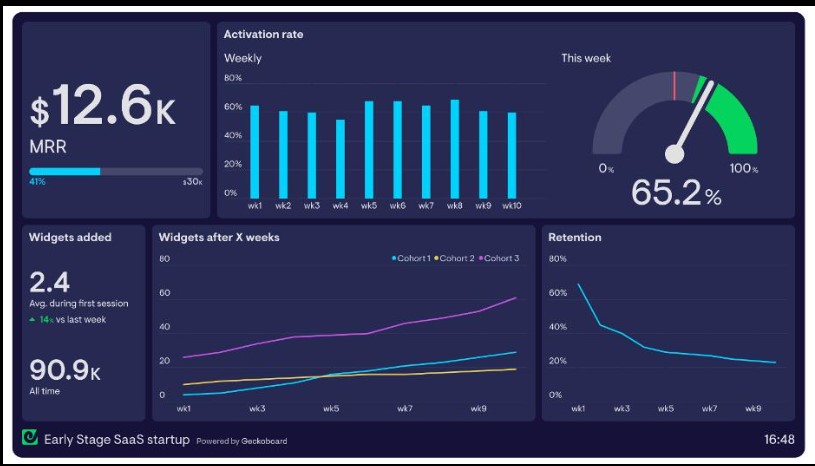
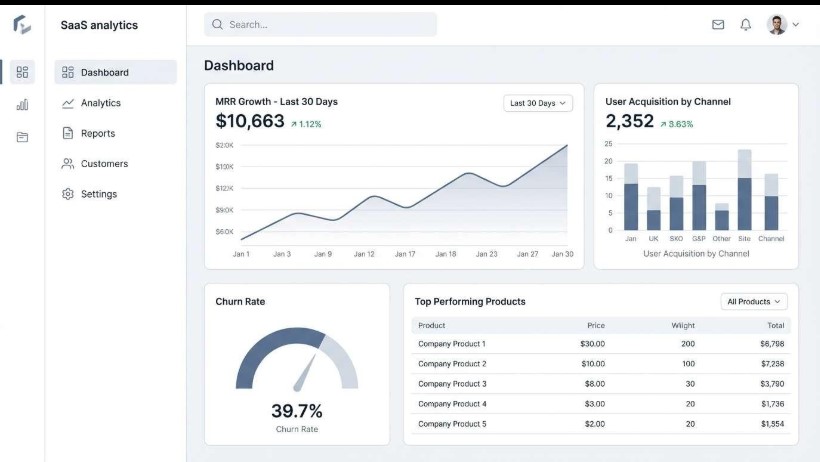
Step 16: Measure the Right Numbers
Once customers begin using your product, start measuring its performance.
Important SaaS metrics can include:
Monthly Recurring Revenue
How much subscription revenue the business generates each month.
Customer Churn
How many customers cancel their subscriptions.
Customer Acquisition Cost
How much it costs to acquire a customer.
Lifetime Value
How much revenue a customer generates during their relationship with the business.
Activation Rate
How many new users reach the point where they actually experience the product’s core value.
Retention
How many customers continue using the product over time.
You do not need a giant analytics department.
A simple dashboard can be enough in the beginning.
The important thing is understanding whether customers are staying and receiving value.
Step 17: Don’t Confuse Growth With Success
The startup world often celebrates enormous numbers.
Millions of users.
Millions in funding.
Rapid hiring.
Huge valuations.
But a micro-SaaS business can have a completely different definition of success.
Imagine a founder creates a product that earns:
$10/month × 100 customers = $1,000/month
That is not a massive technology company.
But it is real recurring revenue.
Now imagine:
$25/month × 400 customers = $10,000/month
That can become a meaningful business for a small team.
The objective of micro-SaaS is often sustainable economics rather than unlimited growth.
A founder may prefer a small profitable company they control instead of raising large amounts of capital and building a huge organization.
That is one reason the bootstrapped model is attractive.
10 Micro-SaaS Ideas You Can Explore
If you are looking for SaaS startup ideas, start by examining narrow problems rather than trying to invent a giant platform.
Here are some examples:
1. Appointment Reminder Tool
A simple reminder system for a specific professional niche.
2. Invoice Follow-Up Tool
Automatically reminds clients about unpaid invoices.
3. Social Caption Generator for a Specific Industry
Instead of generating captions for everyone, focus on one niche such as restaurants, real estate agents or beauty businesses.
4. Review Request Software
Helps small businesses automatically request customer reviews after a purchase.
5. Simple Reporting Tool
Converts data from a specific platform into a simple report for a specific type of business.
6. Document Expiration Tracker
Reminds companies when licenses, certificates or contracts are approaching expiration.
7. Client Onboarding Tool
Automates the process of collecting information from new customers.
8. Content Approval Tool
Helps small agencies get social media content approved by clients.
9. Niche Inventory Alert Tool
Alerts a specific type of business when important inventory reaches a certain threshold.
10. Workflow Automation Tool
Automates one repetitive process for one particular profession.
Notice the pattern.
The best ideas are not necessarily:
“Build a new Facebook.”
They are often:
“Help this specific group stop doing this annoying task manually.”
Mistakes to Avoid When Starting a Micro-SaaS
Building Before Talking to Customers
You can spend six months building something nobody wants.
Validate first.
Trying to Serve Everyone
A broad audience makes your marketing and product decisions harder.
Start narrow.
Adding Too Many Features
More features create more development, testing and support requirements.
Solve the core problem first.
Choosing an Idea Because It Sounds Cool
Technology is exciting.
But customers pay for outcomes.
Ignoring Customer Support
Even a tiny SaaS product needs responsive support.
Your first customers should feel that someone is listening.
Underpricing
If your software saves significant time or money, do not automatically assume it should cost only a few dollars.
Overcomplicating the Technology
A micro-SaaS should remain micro in its infrastructure and operations where practical.
Chasing Competitors
Competitors can provide useful information, but copying everything they do will turn your product into another version of theirs.
Find your own specific advantage.
A Simple 30-Day Micro-SaaS Launch Plan
If you want a practical starting point, you can divide your first month into four stages.
Week 1: Research
Find a specific audience.
Talk to potential customers.
List their repetitive problems.
Choose one problem that appears frequently.
Week 2: Validation
Interview more potential customers.
Create a simple landing page.
Explain the proposed solution.
Collect email addresses or early-access signups.
Try to identify people willing to pay.
Week 3: Build
Create the smallest useful version.
Avoid unnecessary features.
Set up authentication, payments and the core workflow.
Test everything.
Week 4: Launch
Invite your first users.
Watch how they use the product.
Fix critical problems.
Collect feedback.
Charge for the product.
Then improve based on real usage.
The process does not end after 30 days.
That is simply the beginning.
The Real Secret of Micro-SaaS
The most important skill in micro-SaaS entrepreneurship is not coding.
It is problem selection.
A talented developer can build a technically impressive application and still fail because the problem is insignificant.
Meanwhile, a simple application can succeed because it removes a painful task for a group of customers who are willing to pay.
Think about the difference between complexity and value.
A complicated product is not necessarily valuable.
A simple product is not necessarily unimportant.
If your software saves a customer two hours every week, prevents expensive mistakes, increases sales or removes an annoying repetitive task, it has value.
That is what you should optimize for.
Final Thoughts: Start Small, Solve Deeply
Starting a micro-SaaS business does not require you to predict the future of technology.
You do not need to build the next billion-dollar company.
You do not even need an enormous audience.
You need a problem.
A specific group of people experiencing that problem.
A solution that is significantly better, faster, cheaper or easier than what they currently use.
And a business model that allows you to make more money from the solution than it costs to operate it.
The most effective way to approach a micro-SaaS business is therefore surprisingly simple:
Find a small problem.
Find people who care about it.
Validate that they will pay for a solution.
Build the smallest useful product.
Launch it.
Listen to customers.
Improve it.
Charge for the value you provide.
Keep the business focused.
As AI-assisted development and modern cloud tools continue to make software creation more accessible, the technical barrier to launching a small software product is becoming less intimidating. Recent 2026 guides on micro-SaaS similarly emphasize that the opportunity is increasingly about identifying the right customer and problem rather than simply writing more code.
That creates an important opportunity for entrepreneurs.
But it also creates more competition.
When everyone can build software faster, the advantage moves toward the person who understands the customer better.
So don’t start by asking:
“What software should I build?”
Start with:
“Who has a problem that I understand better than most people, and how can I remove that problem with a simple piece of software?”
That question can be the beginning of a profitable micro-SaaS business.
SEO Details
Primary keyword: micro SaaS business
Secondary keywords: SaaS startup ideas, software business, online business model, bootstrapped startup, tech startup guide, digital entrepreneurship, micro SaaS ideas, SaaS business model, solo founder, software startup
Suggested SEO title: How to Start a Micro-SaaS Business by Solving One Small Problem
Suggested meta description: Learn how to start a micro-SaaS business by finding one specific problem, validating demand, building an MVP, getting customers and creating recurring revenue.
Suggested URL slug: how-to-start-a-micro-saas-business
Featured post: Yes
Category: Tech Business & Startups
Tags: micro SaaS business, SaaS startup ideas, software business, online business model, bootstrapped startup, tech startup guide, digital entrepreneurship
Great post
Thank you for this enlightenment..