
Introduction: Agentic AI Is the Next Big Shift After Chatbots
If you have used ChatGPT, Gemini, Claude, Copilot, or any other AI writing tool, you already understand the first major wave of generative AI. You type a request, the AI responds, and you decide what to do next.
That is useful.
But agentic AI goes a step further.
Instead of only answering questions, agentic AI can help plan, decide, take actions, use tools, remember context, and complete multi-step tasks with less human instruction. In simple terms, it is the difference between an AI tool that waits for every command and an AI system that can work through a goal more independently.
For bloggers and small businesses, this is important because the daily workload is becoming too much for one person to handle manually.
A blogger has to research keywords, write outlines, update old posts, create images, send newsletters, track analytics, promote content, manage affiliate links, and check SEO performance.
A small business owner has to answer customers, create invoices, follow up with leads, post on social media, write product descriptions, manage appointments, study competitors, and still run the actual business.
This is where agentic AI becomes powerful.
Agentic AI is not just about “writing faster.” It is about building smarter workflows. It can help you move from doing every task manually to designing systems that assist you across research, planning, content, marketing, customer service, sales, and operations.
But before you rush into using every AI agent tool you see online, you need to understand what agentic AI really means, how it works, what it can do, where it can go wrong, and how to use it safely.
This guide explains agentic AI in a beginner-friendly way for bloggers, freelancers, creators, digital marketers, and small business owners.
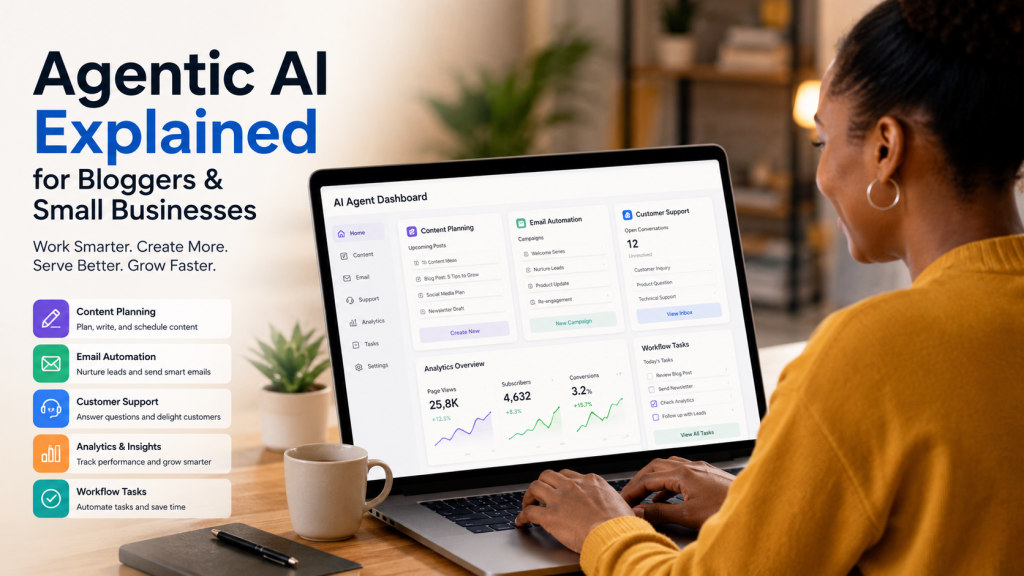
What Is Agentic AI?
Agentic AI is a type of artificial intelligence that can work toward a goal with a level of independence. It can understand an objective, break that objective into steps, use available tools, make decisions, and complete tasks with limited human supervision.
A normal AI chatbot responds to your prompt.
An agentic AI system can take your prompt and turn it into a workflow.
For example, a normal chatbot can help you write a blog outline if you ask for one.
An agentic AI workflow could help you research a topic, find related keywords, compare competitor content, suggest an outline, create a draft, generate FAQs, recommend internal links, and prepare a publishing checklist.
That does not mean it should publish everything without your review. It simply means the AI can handle more of the process instead of waiting for you to give every small instruction.
Here is a simple way to understand it:
Generative AI creates content. Agentic AI completes tasks.
That is not a perfect technical definition, but it is useful for beginners.
Generative AI can write a caption, summarize a document, or draft an email.
Agentic AI can plan a campaign, check multiple sources, use business tools, organize outputs, and help move a task closer to completion.
Agentic AI Explained With a Simple Example
Imagine you own a small digital product business and you want to launch a new ebook.
With a normal AI chatbot, you might ask separate questions like:
“What ebook idea should I create?”
“Write an outline.”
“Write a sales page.”
“Create social media captions.”
“Write email copy.”
“Suggest a launch plan.”
You are still the person managing the whole process manually.
With an agentic AI system, you may give one larger goal:
“Help me plan and prepare a 14-day launch for my new ebook for small business owners.”
The AI agent could then break that goal into smaller tasks:
- Define the target audience
- Suggest a positioning angle
- Create a launch timeline
- Draft the sales page structure
- Write email sequence ideas
- Generate social media post ideas
- Recommend lead magnet ideas
- Build a checklist of tasks before launch
- Ask you for missing information
- Prepare final assets for review
That is the “agentic” part. The AI is not just answering one question. It is acting like a task partner.
Why Agentic AI Matters in 2026
Agentic AI matters because businesses are moving from simple AI experimentation to practical AI execution.
In the early days of AI adoption, many people used AI for basic tasks like writing captions, summarizing text, generating blog ideas, or rewriting emails. That was helpful, but it still required a lot of human control.
In 2026, the bigger opportunity is workflow automation.
People do not just want AI that writes. They want AI that helps them get work done.
For bloggers, that may mean using AI agents to support SEO research, content updates, affiliate product comparisons, content briefs, and social repurposing.
For small businesses, it may mean using AI agents for lead follow-up, customer service, appointment scheduling, proposal writing, competitor monitoring, and internal documentation.
The business value is not in using AI because it is trendy. The value is in reducing repetitive work, improving speed, and giving the owner more time to focus on strategy, customers, product quality, and revenue.
Agentic AI is becoming part of the future of automation because it can connect reasoning with action.
Agentic AI vs Generative AI: What Is the Difference?
Many beginners confuse generative AI and agentic AI because both can use similar models.
The difference is in how they behave.
Generative AI is mostly reactive. You ask for something, and it produces content or an answer.
Agentic AI is more goal-driven. You give it an objective, and it can plan steps, use tools, remember context, and take actions toward that objective.
Here is a simple comparison:
Generative AI:
- Writes text
- Creates images
- Summarizes documents
- Answers questions
- Generates ideas
- Responds when prompted
Agentic AI:
- Plans a task
- Breaks goals into steps
- Uses tools and apps
- Makes decisions within limits
- Performs multi-step workflows
- Works with memory and context
- Can coordinate with other agents
For example, asking AI to “write a blog post about email marketing” is generative AI.
Asking an AI agent to “research email marketing trends, identify five article angles, create an SEO outline, draft the article, suggest internal links, and prepare a publishing checklist” is closer to agentic AI.
The second one is not just creating text. It is helping manage a process.
How AI Agents Work
To understand agentic AI, you need to understand AI agents.
An AI agent is a software system that uses an AI model to pursue a goal or complete a task. The agent may have access to tools, memory, data, instructions, and external applications.
A basic AI agent usually has these parts:
1. Goal
The agent needs a goal. This is what you want it to achieve.
Example:
“Find content opportunities for my blog in the AI tools niche.”
Without a goal, the agent has no direction.
2. Reasoning
The agent uses an AI model to understand the task and decide what steps are needed.
For example, it may decide that it needs to research keywords, study competing articles, check search intent, and suggest content clusters.
3. Planning
The agent breaks the goal into smaller steps.
This is important because most real business tasks are not one-step tasks. They require a sequence.
4. Tools
The agent may use tools to complete actions. These tools could include browsers, spreadsheets, email platforms, calendars, CRMs, analytics dashboards, databases, or APIs.
For bloggers, tools might include Google Search Console, keyword research tools, WordPress, email marketing software, and content calendars.
For small businesses, tools might include Gmail, Google Sheets, Notion, Trello, Shopify, Payhip, Gumroad, Stripe, WhatsApp Business, or customer support platforms.
5. Memory
Some AI agents can remember useful context during a task or across tasks. This helps them avoid starting from zero every time.
For example, an agent may remember your brand voice, audience, product list, publishing schedule, or preferred content structure.
6. Action
The agent takes steps toward the goal. This may include creating a document, updating a spreadsheet, drafting an email, organizing research, or preparing a report.
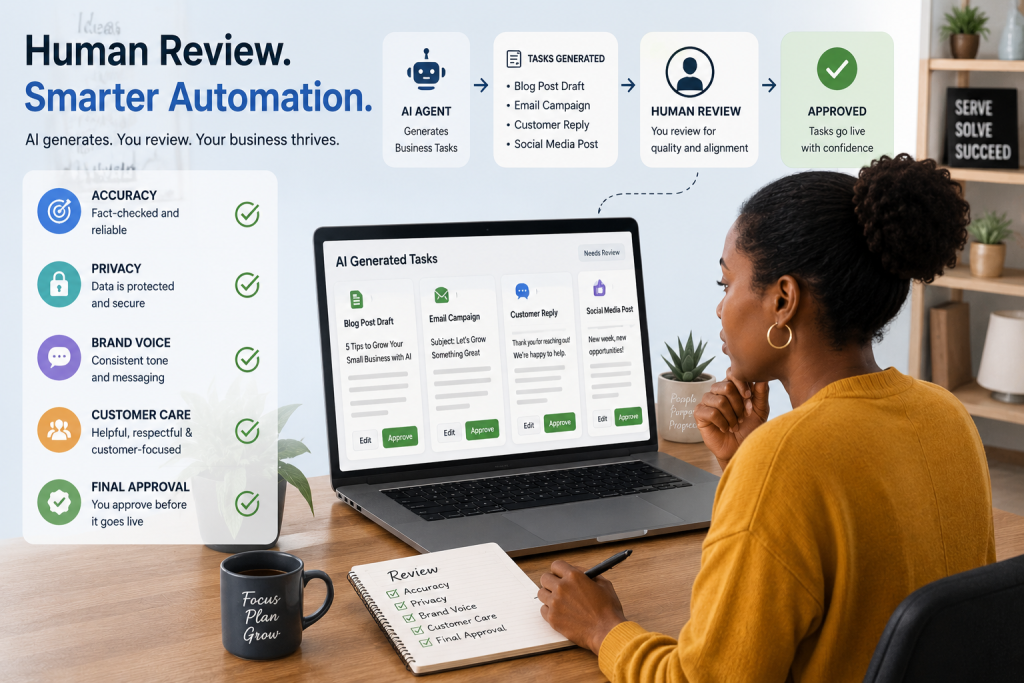
7. Human Review
This is very important. Even if an AI agent can take action, a human should still review important outputs before they go live.
For a blogger, that means checking facts, links, tone, images, and affiliate disclosures.
For a business, that means reviewing customer messages, pricing, contracts, sensitive information, and anything that affects money or reputation.
The Role of Multi-Agent Systems
A multi-agent system uses more than one AI agent to complete a larger goal.
Instead of one AI agent trying to do everything, different agents can handle different roles.
For example, a content workflow could include:
- Research agent
- SEO agent
- Outline agent
- Writing agent
- Editing agent
- Internal linking agent
- Social media repurposing agent
A customer service workflow could include:
- Intake agent
- FAQ agent
- Escalation agent
- Follow-up agent
- Reporting agent
This sounds advanced, but the idea is simple. In a business, one person rarely does everything perfectly. You may have different people for sales, customer support, finance, content, and operations.
Multi-agent systems apply a similar idea to AI workflows.
For bloggers and small businesses, you do not need a complex multi-agent setup on day one. But it is useful to understand where AI tools are heading.
Practical Uses of Agentic AI for Bloggers
Agentic AI can be especially useful for bloggers because blogging involves many repeated workflows.
A successful blog is not just about writing. It includes research, structure, optimization, updates, visuals, promotion, analytics, and monetization.
Here are practical ways bloggers can use agentic AI.
1. Content Research
An AI agent can help you research a topic before writing. It can collect subtopics, common questions, competitor angles, related keywords, and reader pain points.
For example, if you run a tech blog, you could ask an AI workflow to research:
“Best AI tools for small business owners in 2026.”
The agent could help identify:
- Search intent
- Common reader questions
- Product categories
- Comparison angles
- Use cases
- Related articles to write
- Potential internal links
This does not replace your judgment. It gives you a starting point faster.
2. SEO Content Briefs
A good blog post starts with a strong content brief. Many bloggers skip this stage and go straight into writing. That often leads to weak structure.
Agentic AI can help build a content brief that includes:
- Main keyword
- Secondary keywords
- Search intent
- Target reader
- Suggested title
- H2 and H3 structure
- Questions to answer
- Internal link suggestions
- External source suggestions
- CTA idea
- Image ideas
This is useful if you want to publish consistently without losing quality.
Recommended internal backlink: Link this section to your TechProfitHub article on Best AI SEO Tools for Bloggers Who Want Faster Rankings.
3. Updating Old Blog Posts
Old posts can lose traffic if they become outdated. Agentic AI can help you identify which posts need updates.
A workflow could review old content and suggest:
- Outdated statistics
- Missing sections
- Weak intros
- Broken links
- Poor internal linking
- New FAQs
- Better meta descriptions
- Opportunities for affiliate links
This is one of the best uses of AI for bloggers because updating old content can sometimes bring faster results than publishing completely new posts.
4. Repurposing Content
A single blog post can become many pieces of content.
Agentic AI can help turn one article into:
- LinkedIn post
- Facebook caption
- Twitter/X thread
- Pinterest pin title
- Newsletter summary
- YouTube short script
- Instagram carousel outline
- WhatsApp broadcast message
This saves time and helps you promote your content more effectively.
5. Affiliate Content Planning
If your blog earns through affiliate marketing, agentic AI can help plan better product-review and comparison content.
It can help you create:
- Product review outlines
- Comparison tables
- Pros and cons sections
- Buying guide questions
- Feature checklists
- User-intent breakdowns
- Disclosure reminders
However, you must still check product details manually. Pricing, features, and product availability can change quickly. Never publish AI-generated product claims without verifying them.
Practical Uses of Agentic AI for Small Businesses
Small businesses often have limited staff, limited time, and limited budget. That is exactly why agentic AI can be valuable.
It can help owners reduce repetitive tasks and create better systems.
1. Customer Support
Many customer questions repeat every day.
Customers ask about pricing, delivery, opening hours, refund policies, product details, appointment slots, and how to order.
An AI agent can help draft replies, sort messages, prepare FAQs, and escalate serious issues to a human.
For example, a small online store could use AI to organize customer questions into categories:
- Order status
- Product questions
- Payment issues
- Refund requests
- Delivery questions
- Complaints
The business owner can then respond faster and more professionally.
But be careful. Sensitive customer issues should not be left fully to AI. Anything involving refunds, private information, legal complaints, or emotional situations should be reviewed by a human.
2. Lead Follow-Up
Many small businesses lose money because they do not follow up with interested customers.
An AI workflow can help create follow-up messages for:
- New inquiries
- Abandoned carts
- Consultation requests
- Old leads
- Event attendees
- Webinar participants
- Past customers
For example, a digital agency could use agentic AI to draft a three-message follow-up sequence after someone asks about website design.
The owner can review and send the message, instead of writing from scratch every time.
3. Social Media Planning
A small business owner may know their product well but struggle to post consistently.
Agentic AI can help create a weekly content plan around:
- Educational posts
- Promotional posts
- Behind-the-scenes content
- Customer testimonials
- FAQs
- Product benefits
- Founder story
- Seasonal campaigns
The AI can also repurpose one topic into multiple formats.
For example:
Topic: “Why your business needs a professional email address.”
The AI can turn this into:
- Instagram caption
- LinkedIn post
- Facebook post
- Short video script
- Blog post outline
- Email newsletter
4. Business Documentation
Many small businesses operate without clear systems. Everything is in the owner’s head.
Agentic AI can help create basic business documents like:
- SOPs
- Staff onboarding guides
- Customer service scripts
- Sales process documents
- Product descriptions
- Training checklists
- Weekly reporting templates
- Meeting summaries
This is powerful because documentation helps a business become less chaotic.
5. Research and Competitor Monitoring
A small business can use AI agents to monitor trends, competitors, customer reviews, and market changes.
For example, a restaurant owner may want to know:
- What similar restaurants are posting
- What customers complain about
- What promotions competitors are running
- What menu items are trending
- What local search keywords people use
An AI agent can help organize this research into a readable report.
6. Email and Admin Work
Email can quietly waste hours every week.
Agentic AI can help with:
- Drafting replies
- Summarizing long emails
- Prioritizing messages
- Creating meeting notes
- Preparing follow-ups
- Turning conversations into tasks
- Creating weekly summaries
This does not mean AI should take over your inbox completely. It means AI can reduce the manual burden.
Benefits of Agentic AI for Bloggers and Small Businesses
Agentic AI has many potential benefits when used properly.
1. Saves Time
This is the most obvious benefit. AI agents can reduce the time spent on repetitive tasks.
Instead of manually creating a content calendar every week, you can use AI to draft one and then edit it.
Instead of writing every customer reply from scratch, you can use AI to prepare a response and personalize it.
The time saved can be used for strategy, customer relationships, product improvement, and sales.
2. Improves Consistency
Many bloggers and small businesses struggle with consistency.
They post for one week, disappear for two weeks, then come back again.
Agentic AI can help maintain consistency by supporting planning, reminders, drafts, and workflows.
Consistency matters because audiences trust brands that show up regularly.
3. Reduces Mental Load
Running a blog or business involves constant decision-making.
What should I post?
What should I write?
What should I reply?
What should I promote?
What should I update?
What should I track?
AI agents can help reduce decision fatigue by organizing options and suggesting next steps.
4. Helps Small Teams Do More
A small team cannot always hire a full marketing department, admin assistant, content strategist, and customer support team.
Agentic AI can support some of these functions, especially at the planning and drafting stage.
It will not replace good human judgment, but it can help a small team work smarter.
5. Makes Automation More Accessible
Traditional automation often required technical skills. You had to understand integrations, triggers, APIs, and workflows.
Agentic AI makes automation easier to understand because you can describe a goal in natural language.
Instead of thinking only in technical steps, you can say what you want to achieve and let the system help structure the process.
Risks and Limitations of Agentic AI
Agentic AI is powerful, but it is not magic. It comes with real risks.
1. AI Can Make Mistakes
AI tools can produce wrong information, outdated details, or confident-sounding errors.
This is especially risky for blog posts, product reviews, financial content, legal topics, health topics, and technical guides.
Always verify important claims.
2. AI Can Misunderstand Instructions
An AI agent may take the wrong action if the instruction is unclear.
For example, if you ask it to “email all leads,” but your lead list includes old or unqualified contacts, it may prepare messages for the wrong people.
Clear instructions and human review are necessary.
3. Privacy Risks
If you connect AI tools to your business systems, you must be careful with customer data, passwords, private documents, and financial information.
Do not paste sensitive data into random AI tools without understanding their privacy policies.
Recommended internal backlink: Link this section to your TechProfitHub article on Cybersecurity Essentials for Small Digital Businesses in 2026.
4. Over-Automation
Not every task should be automated.
Some customer conversations need empathy. Some decisions need personal judgment. Some content needs lived experience.
If you automate everything, your brand may become cold and generic.
The best use of agentic AI is not to remove humans. It is to help humans work better.
5. Poor Quality Content
If bloggers use agentic AI only to mass-produce articles without human editing, the result can become thin, generic, and unhelpful.
That is not a good long-term SEO strategy.
Search engines and readers reward content that is useful, clear, accurate, and trustworthy.
How to Use Agentic AI Without Losing Your Human Voice
This is where many bloggers and small businesses get it wrong.
They use AI, but the content starts sounding empty. It becomes too polished, too broad, and too similar to every other article online.
To avoid that, use agentic AI as a support system, not as your full voice.
Here are practical ways to keep your content human.
1. Add Your Own Experience
AI can explain a topic, but it cannot replace your real business experience.
Add examples from your own work.
For example:
“In my experience, the best use of AI for small businesses is not writing random captions. It is creating repeatable systems for tasks that happen every week.”
That kind of sentence feels human because it shows judgment.
2. Add Real Scenarios
Use examples your audience can recognize.
For bloggers:
“Imagine you have 40 old blog posts and you do not know which one to update first.”
For small businesses:
“Imagine 15 customers ask the same delivery question every day on WhatsApp.”
These examples make the article more useful.
3. Edit AI Output Aggressively
Do not publish raw AI text.
Rewrite weak sections. Remove fluff. Add clarity. Check facts. Add screenshots. Add internal links. Improve headings. Add your own opinion.
The editing stage is where authority is built.
4. Keep the Reader in Mind
A beginner does not need a complicated technical explanation first. They need to understand what the technology means for their daily work.
Ask yourself:
“Can a busy business owner understand this in five minutes?”
If the answer is no, simplify it.
5. Use AI for Structure, Not Identity
AI can help with outlines, drafts, tables, summaries, and checklists.
But your brand identity should still come from you.
Your examples, your values, your warnings, your recommendations, and your experience are what make the content different.
Best Agentic AI Tools and Platforms to Watch
The agentic AI space is changing quickly. New tools are appearing often, and existing platforms are adding agent-like features.
For beginners, it is better to understand categories rather than chase every tool.
1. AI Assistants With Agent Features
These are tools that can help with writing, research, planning, and task support.
Examples include major AI assistants such as ChatGPT, Claude, Gemini, Copilot, and similar platforms.
Some of these tools are increasingly adding memory, file handling, browsing, workflow, and tool-use abilities.
2. AI Automation Platforms
These platforms help connect different apps and automate workflows.
They may integrate AI into business processes like email, forms, CRMs, spreadsheets, and notifications.
Examples include tools like Zapier, Make, and other automation platforms.
3. AI Customer Support Tools
These tools help businesses answer customer questions, organize support tickets, and provide faster responses.
They can be useful for ecommerce stores, service businesses, agencies, SaaS businesses, and online communities.
4. AI Content Workflow Tools
These tools help bloggers and marketers plan, create, optimize, and repurpose content.
They may support keyword research, content briefs, writing, editing, SEO, social posts, and content calendars.
Recommended internal backlink: Link this section to your TechProfitHub article on The 2026 Remote Work Tech Stack: Productivity Beyond the Office.
5. Developer Agent Frameworks
These are more technical platforms used by developers to build custom agents.
If you are not technical, you do not need to start here. But it is useful to know that many advanced AI agents are built with frameworks that allow tool use, memory, planning, and multi-step execution.
How Bloggers Can Start Using Agentic AI Today
You do not need to build a complex AI system. Start with one simple workflow.
Here is a beginner-friendly approach.
Step 1: Choose One Repetitive Task
Do not try to automate your entire blog.
Choose one task that takes too much time.
Examples:
- Creating blog outlines
- Updating old articles
- Writing meta descriptions
- Creating social posts from articles
- Finding FAQ ideas
- Building email newsletters
- Organizing keyword ideas
Step 2: Write the Process Manually Once
Before using AI, write down how you currently do the task.
For example, your blog outline process may look like this:
- Choose topic
- Check search intent
- Find related questions
- Study top-ranking pages
- Create H2 structure
- Add FAQs
- Add CTA
- Add internal link ideas
Once you understand the process, you can ask AI to help with each step.
Step 3: Create a Reusable Prompt
Turn the process into a reusable instruction.
Example:
“Act as an SEO content strategist. Help me create a content brief for the topic below. Include search intent, target reader, suggested title, H2/H3 outline, FAQ ideas, internal link suggestions, external source suggestions, image ideas, and CTA. Keep the tone beginner-friendly and practical.”
Now you have a reusable workflow.
Step 4: Review the Output
AI should not be your final editor. You are still responsible for the quality.
Check:
- Facts
- Tone
- Search intent
- Repetition
- Originality
- Links
- Images
- CTA
- Reader value
Step 5: Improve Over Time
Every time you use the workflow, improve it.
Add more specific instructions. Remove weak steps. Add your brand voice. Create templates.
This is how a simple AI prompt becomes a real business system.
How Small Businesses Can Start Using Agentic AI Today
Small businesses should also start simple.
Step 1: Pick One Business Area
Choose one area where you waste time.
Examples:
- Customer questions
- Lead follow-up
- Social media planning
- Product descriptions
- Weekly reports
- Email replies
- Appointment reminders
Step 2: Create a Clear Rule
AI works better when your business rules are clear.
For example:
“If a customer asks about price, provide the current price list and invite them to place an order.”
“If a customer complains, apologize and ask for the order number before escalating.”
“If a lead asks for website design, send our service overview and ask for their business type.”
These rules help the AI produce better responses.
Step 3: Keep Human Approval
At the beginning, do not allow AI to send important messages automatically.
Let it draft. You review. Then you send.
This protects your reputation.
Step 4: Build Templates
Create templates for repeated tasks.
Examples:
- Inquiry reply
- Payment confirmation
- Delivery update
- Appointment reminder
- Proposal follow-up
- Testimonial request
- Refund response
AI can then personalize these templates faster.
Step 5: Track Results
Do not use AI blindly. Track whether it helps.
Ask:
- Are replies faster?
- Are customers happier?
- Are leads followed up better?
- Are posts more consistent?
- Is the owner saving time?
- Are errors reducing?
If the answer is yes, the workflow is useful.
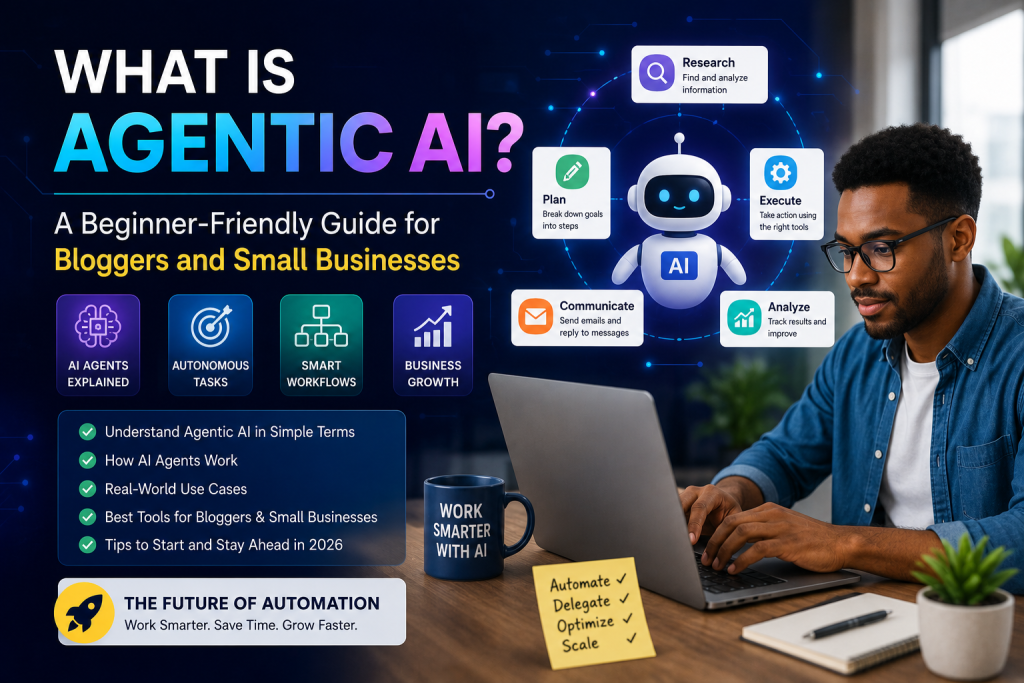
Agentic AI Use Case Examples for Different Business Types
For a Blogger
Goal: Publish two high-quality articles per week.
Agentic AI workflow:
- Research topic ideas
- Create SEO briefs
- Draft outlines
- Suggest internal links
- Generate FAQ ideas
- Prepare social media captions
- Create newsletter summary
- Track update opportunities
Human role:
- Choose final topics
- Add experience
- Check facts
- Edit tone
- Approve publishing
For a Digital Agency
Goal: Handle client content planning faster.
Agentic AI workflow:
- Review client niche
- Suggest content themes
- Create monthly calendar
- Draft captions
- Prepare campaign ideas
- Summarize performance reports
- Suggest next actions
Human role:
- Approve strategy
- Manage client relationship
- Adjust brand voice
- Confirm offers and pricing
For an Online Store
Goal: Improve product marketing and customer support.
Agentic AI workflow:
- Draft product descriptions
- Answer common questions
- Create promotional emails
- Suggest upsell ideas
- Track customer complaints
- Prepare weekly sales summary
Human role:
- Verify product details
- Handle complaints
- Approve promotions
- Manage pricing
For a Coach or Consultant
Goal: Generate leads and manage client communication.
Agentic AI workflow:
- Create lead magnet ideas
- Draft email sequences
- Prepare discovery call questions
- Summarize client notes
- Create follow-up emails
- Suggest content topics
Human role:
- Deliver coaching
- Build trust
- Review client-sensitive content
- Make strategic decisions
For a Freelancer
Goal: Get more clients and manage work professionally.
Agentic AI workflow:
- Improve portfolio copy
- Draft proposals
- Create client onboarding documents
- Prepare project timelines
- Write follow-up messages
- Summarize completed work
Human role:
- Build relationships
- Price services
- Deliver quality work
- Negotiate contracts
Agentic AI and SEO: What Bloggers Should Know
Agentic AI can support SEO, but it should not be used to create low-quality mass content.
A good SEO strategy still depends on value.
If you use AI agents to produce hundreds of generic articles with no unique insight, readers will notice. Search engines may also struggle to see why your content deserves attention.
Use agentic AI to improve the process, not to avoid quality.
For SEO, AI agents can help with:
- Topic clustering
- Keyword grouping
- Content briefs
- Internal linking
- Content refresh plans
- FAQ research
- Meta descriptions
- Image alt text
- Schema suggestions
- Competitor gap analysis
But humans should still handle:
- Final editorial judgment
- Experience-based insight
- Fact-checking
- Product testing
- Original examples
- Brand voice
- Ethical disclosures
The strongest blogs in the AI age will not be the ones that publish the most AI content. They will be the ones that use AI to create more helpful, organized, accurate, and experience-rich content.
Agentic AI and AdSense: What Publishers Should Consider
If your blog uses or plans to use Google AdSense, you need to be careful with content quality and policy compliance.
AdSense-friendly content should be useful, original, safe for advertisers, and created for real readers.
Avoid:
- Thin AI-generated pages
- Misleading claims
- Copied content
- Dangerous or harmful instructions
- Fake reviews
- Clickbait titles that do not match the article
- Excessive ads that disturb reading
- Content created only to manipulate search traffic
Agentic AI can help you produce better content workflows, but it should not become an excuse to publish weak content.
A good AdSense-friendly AI article should include:
- Clear topic focus
- Helpful explanation
- Original examples
- Accurate information
- Proper sources
- Good formatting
- Useful images
- Natural internal links
- Clear CTA
- Human editing
That is how you protect your site for the long term.
The Future of Agentic AI for Small Businesses
Agentic AI is still developing, but the direction is clear.
AI tools are moving from simple chat to action-based workflows. In the future, more small businesses may use AI agents to manage parts of customer service, marketing, operations, finance, reporting, and internal systems.
However, the most successful businesses will not be the ones that automate everything blindly.
They will be the ones that combine AI speed with human trust.
Customers still want honesty. Readers still want useful information. Clients still want good judgment. Search engines still want helpful content.
Agentic AI is a tool. It is not a replacement for business sense.
For a blogger, it can help you publish better and faster.
For a small business, it can help you respond faster and organize your operations.
For a freelancer, it can help you package your services and deliver work more professionally.
For a digital agency, it can help you scale workflows without losing control.
But in every case, the human still matters.
Beginner Checklist: How to Start With Agentic AI
Before you use agentic AI in your blog or business, go through this checklist.
- Choose one task to improve
- Write down your current process
- Identify what AI can help with
- Keep sensitive data private
- Create a clear prompt or workflow
- Test the output
- Review before publishing or sending
- Track time saved
- Improve the workflow
- Scale only when it works
Do not start with the most complicated setup. Start with one useful workflow.
Common Questions About Agentic AI
Is agentic AI the same as ChatGPT?
Not exactly. ChatGPT is an AI assistant that can support many tasks, and some versions or connected workflows may include agent-like features. Agentic AI is a broader concept. It refers to AI systems that can plan, use tools, and complete multi-step tasks toward a goal.
Can agentic AI run my whole business?
No. At least, it should not run your whole business without human oversight. Agentic AI can support workflows, but humans should still handle strategy, quality control, customer trust, sensitive decisions, and final approval.
Is agentic AI safe for small businesses?
It can be useful when used carefully. The main safety issues involve privacy, wrong information, over-automation, poor instructions, and lack of review. Start with low-risk tasks before connecting AI to important business systems.
Can bloggers use agentic AI for SEO?
Yes. Bloggers can use agentic AI for research, outlines, content briefs, internal linking ideas, old post updates, FAQs, and repurposing. But AI-generated content should always be edited, fact-checked, and improved with human experience.
Will agentic AI replace freelancers?
Agentic AI may change how freelancers work, but it does not remove the need for skilled humans. Freelancers who learn how to use AI workflows may become more productive and more valuable. The risk is higher for freelancers who only offer basic, generic tasks without strategy or judgment.
What is the best way to start?
Start with one repetitive task. For example, use AI to create weekly content briefs, draft customer replies, summarize emails, or generate social media ideas. Review the results and improve the process before expanding.
Conclusion: Agentic AI Is Not Just a Trend, It Is a New Way to Work
Agentic AI is one of the most important AI trends for bloggers and small businesses because it moves beyond simple content generation.
It is not just about asking AI to write a paragraph.
It is about using AI to support goals, workflows, decisions, and repeated business tasks.
For bloggers, agentic AI can help with research, SEO briefs, content updates, repurposing, affiliate planning, and publishing workflows.
For small businesses, it can help with customer support, lead follow-up, social media planning, documentation, email management, and business operations.
But the best results will come from balance.
Use AI for speed.
Use human judgment for trust.
Use automation for repeated tasks.
Use your experience for authority.
Use agents for workflow support.
Use yourself for final decisions.
Agentic AI will not automatically make a blog successful or a business profitable. But when used properly, it can help you save time, organize your work, improve consistency, and compete more effectively in a digital world that keeps moving faster.
Call to Action
If you are a blogger or small business owner, do not wait until agentic AI becomes complicated before you start learning.
Pick one task this week that takes too much of your time. It could be content planning, customer replies, blog outlines, email summaries, or social media captions.
Then build one simple AI-assisted workflow around it.
Start small. Test carefully. Keep human review. Improve the system.
That is how you turn agentic AI from a buzzword into a real business advantage.