

The digital landscape of 2026 is unrecognizable to those who started their journey even five years ago. We have moved past the “Content is King” era and entered the “Authority is Everything” epoch. For small publishers, the stakes have never been higher. The “Great Filter” of 2025 wiped out millions of low-quality niche sites that relied on thin content and basic SEO hacks. Today, the internet is saturated with AI-generated noise, and search engines have pivoted from being “link engines” to “answer engines.”

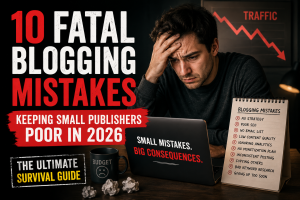
Traditional blogging—the act of simply writing 800-word articles and slapping on some display ads—is officially dead. Small publishers who continue to follow the 2020 playbook are finding themselves with declining traffic, zero engagement, and empty bank accounts. However, a new breed of “Smart Publishers” is thriving. These individuals treat their blogs not as journals, but as multi-channel media empires. They understand that in an AI-dominated world, the “Humanity Premium” is the most valuable currency. They don’t just chase keywords; they build ecosystems. If you are struggling to break through the noise, it is likely because you are clinging to outdated methodologies that the algorithms now actively penalize.
In this extensive guide, we will dissect the ten critical blogging mistakes that are keeping small publishers poor in 2026. We will explore why these errors are fatal and provide a roadmap for pivoting toward a high-growth, high-revenue model. Whether you are looking to refine your blogging and digital skills or seeking to integrate the latest AI tools and automation, this analysis is your blueprint for success in the modern web.
Mistake #1: Over-reliance on Unrefined AI Content (The ‘AI Sludge’ Epidemic)
By 2026, the internet has been flooded with what experts call “AI Sludge”—generic, repetitive, and factually hollow content generated by unrefined LLMs (Large Language Models). Many small publishers, lured by the promise of “infinite content,” have automated their entire production process without human oversight. This is a catastrophic mistake. Google’s “Helpful Content” algorithms have evolved to detect the lack of “Information Gain.” If your article doesn’t provide a new perspective, unique data, or personal experience that isn’t already in the training data of the AI, it will be buried.
Smart publishers use AI as a co-pilot, not the captain. They use it for outlining, research, and data synthesis, but the final output is heavily infused with human voice and “Proof of Experience.”
Pro Tip: Use the “Search for the Gap” method. Before writing, ask an AI to summarize the top 5 articles on your topic. Whatever the AI doesn’t mention—personal failures, specific local nuances, or contrarian data—is exactly what your article should focus on.
Best Smartphones in 2026: Full Comparison Guide (Top Mobile Devices Ranked)
The difference is Information Gain. The examples above provide specific, anecdotal evidence that an AI cannot replicate without being prompted by a human with real-world experience. According to [Source: Search Engine Journal], sites that rely 100% on raw AI output saw a 70% drop in organic reach in the first quarter of 2026.
Mistake #2: Ignoring the “Zero-Click” Search Reality
The rise of AI Overviews (formerly SGE) has fundamentally changed how users interact with search results. In 2026, over 65% of searches result in “zero clicks” because the AI provides the answer directly on the search results page. Small publishers who are still optimizing for “blue links” are losing. The mistake is fighting the AI instead of becoming the source for the AI.
To survive, you must optimize for “Featured Snippets” and “AI Citations.” This involves:
- Using clear, concise definitions at the beginning of sections.
- Implementing advanced Schema Markup (JSON-LD) to help AI understand your entities.
- Creating “Data-Rich” tables and lists that AI models love to scrape and cite.
Pro Tip: Structure your content using the “Inverted Pyramid” style. Give the definitive answer in the first 50 words, then spend the rest of the article providing the “Why” and “How” that the AI overview lacks the depth to cover.
If the AI uses your content as its primary source, you gain the “Citation Click,” which is often higher quality than a standard organic click. We discussed this in our previous guide on digital growth, emphasizing that being the “Authority Source” is the only way to bypass the zero-click barrier.
Mistake #3: Weak Personal Brand and Lack of ‘E-E-A-T’
In 2026, “faceless” blogs are a dying breed. With the ease of content generation, trust has become the ultimate differentiator. Google’s E-E-A-T (Experience, Expertise, Authoritativeness, Trustworthiness) guidelines are now the primary ranking factor. If your “About Us” page is generic and your articles don’t have a real author with a verifiable digital footprint, you will not rank.
Small publishers often make the mistake of hiding behind a brand name. In 2026, users want to know who is talking to them. This means:
- Building a LinkedIn presence that mirrors your blog’s niche.
- Including “Author Boxes” with links to social profiles and professional credentials.
- Using “I” and “We” to signify personal involvement in the topic.
Pro Tip: Create a “Transparency Report” or a “How We Test” page. Documenting your process—whether it’s how you research articles or how you test products—builds massive “Trust” points with both users and algorithms.
As noted by [Source: Forbes], the “Humanity Premium” allows creators to charge 5x more for their products and services compared to faceless entities. Your blog is no longer just a website; it is a resume of your expertise.
Mistake #4: Neglecting First-Party Data (The Death of Cookies)
The total phase-out of third-party cookies has left many small publishers in the dark. Those who relied solely on retargeting ads and third-party analytics to understand their audience are now blind. The mistake is not owning your audience data. If your primary way of reaching your readers is through a third-party platform (like Google or Facebook), you don’t have a business; you have a lease that can be canceled at any time.
The 2026 Newsletter Strategy: From Broadcast to Conversation
In 2026, a newsletter is no longer a “weekly roundup.” It is a personalized data-collection engine. To thrive, small publishers must implement a Hyper-Segmented Newsletter Strategy:
- The Zero-Party Data Hook: Instead of a generic “Join my newsletter,” use interactive quizzes. For example, “What is your #1 blogging bottleneck?” The answer segments the user immediately into a specific bucket (e.g., “Technical SEO” or “Monetization”).
- Micro-Newsletters: Instead of one massive list, run 3-4 “Micro-Newsletters” based on those segments. A user interested in AI tools shouldn’t receive your updates on lifestyle blogging. This keeps open rates above 50% in an era of inbox fatigue.
- AI-Driven Personalization: Use tools like Beehiiv or ConvertKit’s 2026 AI suite to dynamically insert content blocks. If a user has clicked on “Affiliate Marketing” links in the past, the top of their newsletter should feature your latest affiliate strategy guide.
- The “Reply-Back” Loop: 2026 algorithms prioritize “Engagement signals.” End every email with a specific question and manually reply to the first 10 responses. This signals to email providers (Gmail, Outlook) that your content is highly valued, ensuring you stay out of the “Promotions” tab.
Pro Tip: Offer a “Text-Only” version of your newsletter. In 2026, many high-value readers use AI agents to summarize their emails. Clean, text-heavy emails are more easily parsed and prioritized by these agents.
By collecting emails and preferences directly, you can create personalized experiences that AI-driven ad networks cannot match. This is a core component of modern monetization strategies.
Mistake #5: Slow Technical Performance and Poor UX
Core Web Vitals are no longer a “bonus” SEO factor; they are a barrier to entry. In 2026, the average user’s attention span has dropped to less than 5 seconds. If your site takes more than 1.5 seconds to load on a mobile device, you are losing half your traffic before they even see your headline.
2026 Hosting and CDN Recommendations
The technical floor has been raised. Shared hosting is a relic of the past. To compete in 2026, your infrastructure must support Edge-Side Rendering (ESR) and HTTP/3.
- Hosting: Move toward “Managed Cloud” solutions like Kinsta or WP Engine that offer isolated containers. For 2026, ensure your host provides NVMe storage and at least 2GB of dedicated RAM for your WordPress instance to handle AI-driven search bots.
- CDN (Content Delivery Network): Standard CDNs are insufficient. You need an AI-Optimized CDN like Cloudflare’s 2026 “Apex” tier. These CDNs use machine learning to predict traffic spikes and pre-cache your content at the “Edge” (the server closest to the user) before the user even clicks.
- Image Formats: Stop using WebP. 2026 is the year of AVIF and JPEG XL. These formats offer 30% better compression without losing the “Retina” quality required for high-end displays.
Pro Tip: Disable all non-essential “Third-Party Scripts.” Every tracking pixel or heat-map tool you add slows down your “Interaction to Next Paint” (INP). If a tool isn’t directly generating revenue, delete it.
A poor UX signals to search engines that your site is “low quality,” leading to a downward spiral in rankings. Invest in premium hosting and a clean, code-light theme.
Mistake #6: Failing to Diversify Revenue (The AdSense Trap)
Relying solely on display ads (like AdSense or Mediavine) is a recipe for poverty in 2026. Ad rates have fluctuated wildly due to AI-generated “Made for Ads” (MFA) sites driving down the value of impressions. Small publishers who don’t diversify are at the mercy of CPM swings.
Successful publishers use a “Revenue Stack” model:
- Affiliate Marketing: Recommending high-quality products with deep-link integration.
- Digital Products: E-books, templates, and mini-courses.
- Sponsorships: Direct deals with brands that bypass the middleman.
- Premium Subscriptions: Gating high-value content for a monthly fee.
Pro Tip: Implement “Contextual Commerce.” Instead of a sidebar ad, use a “Shop the Story” block within your content that links to your own digital products or highly relevant affiliate items. This converts at a 4x higher rate than standard banners.
Diversification isn’t just about making more money; it’s about risk management. If one revenue stream dries up, the others keep the business afloat.
Mistake #7: Poor SEO Strategy for ‘Semantic Search’
The days of “keyword stuffing” are long gone. In 2026, search engines use Semantic Search and Neural Matching to understand the intent behind a query. A common mistake is creating hundreds of disconnected articles targeting individual keywords. This creates “keyword cannibalization” and confuses the search engine about your site’s core topic.
The solution is Topic Clusters:
- Pillar Pages: Comprehensive guides on a broad topic.
- Cluster Content: Specific articles that dive deep into sub-topics, all linking back to the pillar.
- Internal Linking: Creating a “web” of relevance that proves your topical authority.
Pro Tip: Use “Natural Language Questions” as your H2 headers. People in 2026 search via voice and AI agents using full sentences. Instead of “SEO Tips,” use “How do I optimize my blog for AI search engines in 2026?”
By dominating a “Topic” rather than a “Keyword,” you become the go-to resource in your niche, making it much harder for competitors (and AI) to displace you.
Mistake #8: Lack of Video and Multimodal Integration
In 2026, a blog is no longer just text. Search engines are now “multimodal,” meaning they index video, audio, and images alongside text. Small publishers who refuse to step in front of a camera or use voice synthesis are missing out on the fastest-growing segments of web traffic: TikTok, YouTube Shorts, and Instagram Reels.
You must repurpose your written content into:
- Short-form Video: 60-second summaries of your blog posts.
- Web Stories: Visual, tappable content that appears in Google Discover.
- Podcasts: Audio versions of your long-form analysis for users on the go.
Pro Tip: Use AI video generators to create “B-Roll” for your articles. A 30-second video summary embedded at the top of a post can increase “Time on Page” by over 200%, a massive ranking signal.
This “Omnichannel” approach ensures that you meet your audience wherever they are, rather than hoping they find your website through a Google search.
Mistake #9: Under-investing in High-Performance Gear
As a publisher in 2026, your computer is your factory. Many bloggers try to run their business on outdated hardware that can’t handle the demands of modern content production. Between running local AI models for research, editing 4K video for social media, and managing dozens of browser tabs, a standard laptop simply won’t cut it anymore. Time lost to “loading wheels” is money lost to competitors.
To compete at the highest level, you need a machine designed for the AI era. The Apple 2026 MacBook Neo 13-inch with the A18 Pro chip is the gold standard for small publishers. The A18 Pro chip isn’t just about speed; it features a dedicated Neural Engine optimized for local AI processing. This allows you to run your own LLMs locally for content brainstorming without relying on expensive cloud subscriptions or compromising your data privacy.
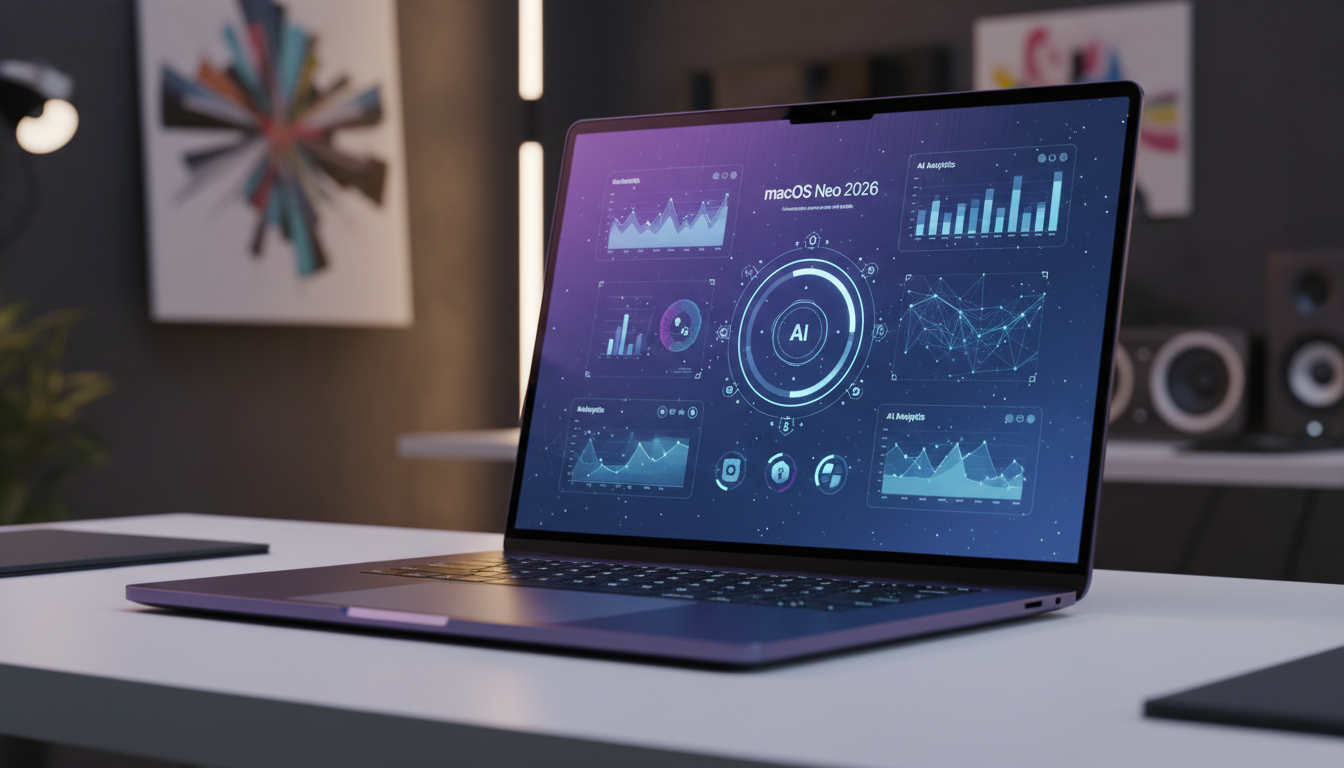

Whether you are rendering a high-definition video for your YouTube channel or using AI to analyze your first-party data, the MacBook Neo provides the thermal efficiency and raw power needed for a 12-hour “deep work” session. Its integration with multimodal tools makes it the ultimate hub for the modern creator.
Invest in your business infrastructure here: Get the Apple 2026 MacBook Neo 13-inch with A18 Pro Chip
Pro Tip: When choosing hardware, prioritize RAM over storage. In 2026, AI applications and browser-based editors are incredibly memory-intensive. 24GB of RAM is the new minimum for a professional publishing workflow.
Don’t let hardware bottlenecks be the reason your publishing empire stalls. In 2026, your gear is just as important as your strategy.
Mistake #10: Thinking Like a Writer, Not a CEO
The final and perhaps most damaging mistake is the “Freelancer Mindset.” Many small publishers spend all their time in the business (writing, editing, social media) rather than on the business (strategy, networking, scaling). If you are the only person who can perform every task, you don’t have a business; you have a high-stress job.
To scale in 2026, you must implement Systems and SOPs (Standard Operating Procedures):
- Automation: Use tools to handle repetitive tasks like social media posting and email sequencing.
- Outsourcing: Hire virtual assistants or specialized freelancers for tasks like graphic design or technical SEO.
- Analytics-Driven Decisions: Stop writing what you “feel” like writing and start writing what the data tells you your audience needs.
Pro Tip: Set a “CEO Day” once a week. On this day, you are forbidden from writing or editing. Your only task is to review your revenue, analyze your traffic data, and plan your content calendar for the next month.
A CEO looks at their blog as an asset that should eventually run without their constant manual labor. This shift in mindset is what separates the “poor blogger” from the “wealthy publisher.”
The Psychology of Stagnation: Why Small Publishers Resist Change
Why, despite the clear evidence that the old ways are failing, do so many small publishers refuse to adapt? The answer lies in the Psychology of Stagnation. Understanding these mental barriers is the first step to overcoming them.
1. The Sunk Cost Fallacy of SEO
Many publishers spent years mastering the art of keyword research and backlink building. In 2026, when those skills are less relevant due to AI-driven search, they experience a “Sunk Cost Fallacy.” They feel that because they invested so much time in the old system, they must continue to use it. This leads to “Algorithmic Anxiety”—a state of constant stress as they watch their rankings drop while refusing to learn the new rules of Semantic Search and E-E-A-T.
2. The Fear of the “Humanity Premium”
Being a “faceless” blogger is safe. It allows for anonymity and protects the ego from personal criticism. However, the 2026 market demands vulnerability. Many publishers resist change because they are afraid to put their face, voice, and personal stories online. They fear that if they become the brand, they are more exposed to failure. Yet, in an AI world, your humanity is your only un-hackable moat.
3. Overwhelmed by the “Multimodal” Shift
The transition from being a “writer” to a “multimedia creator” is daunting. The psychological barrier of learning video editing, podcasting, and AI prompting all at once leads to “Analysis Paralysis.” Instead of taking small steps, publishers do nothing, hoping the “video trend” will pass. It won’t. The web is becoming more visual and auditory every day.
4. The Comfort of the “Content Treadmill”
There is a strange comfort in the “Content Treadmill”—the act of churning out three mediocre posts a week. It feels like work. It provides a sense of accomplishment. However, in 2026, this is “Productive Procrastination.” Publishers do this to avoid the harder, more uncomfortable work of high-level strategy, networking, and product development. They choose the “busy-ness” of writing over the “business” of publishing.
To break free, you must accept that the skills that got you here will not get you to the next level. Growth requires the “Death of the Ego” and a willingness to be a beginner again in the world of AI and multimodal content.
Conclusion: The Roadmap for 2026 and Beyond
The era of “easy” blogging is over, but the era of “profitable” publishing has just begun. The mistakes outlined above—from over-relying on AI sludge to neglecting your personal brand—are the primary reasons why small publishers fail in 2026. However, by recognizing these pitfalls, you have already positioned yourself ahead of 90% of your competition.
To succeed, you must embrace the role of a “Smart Publisher.” This means prioritizing E-E-A-T, mastering Semantic Search, and diversifying your Revenue Stack. It means treating your technical performance as a priority and investing in the high-performance gear, like the MacBook Neo, that allows you to work at the speed of thought. Most importantly, it means building a direct relationship with your audience through first-party data and community engagement.
2027-2030 Outlook: The Rise of the Personal AI Agent
As we look toward the end of the decade, the landscape will shift again. By 2027, we will see the dominance of Personal AI Agents. Users will no longer “browse” the web; their AI agents will do it for them. These agents will be trained on the user’s specific preferences and will “consume” content on their behalf, presenting only the most relevant insights.
For publishers, this means your “audience” will soon consist of both humans and their AI representatives. Content will need to be Machine-Readable but Human-Centric. We will likely see the “Tokenization of Content,” where publishers are paid micro-payments every time an AI agent cites their data or summarizes their unique research. The “Web of Pages” will become a “Web of Entities and Insights.”
Furthermore, the Spatial Web (AR/VR) will integrate with blogging. Your “articles” may become immersive experiences where readers can “walk through” your data or “sit in” on a virtual version of your tutorial. Those who have already mastered multimodal content (Mistake #8) will be the only ones prepared for this transition. The publishers who survive the next four years will be those who stop chasing traffic and start building Irreplaceable Intellectual Property.
For more insights on navigating this transition, explore our latest articles on AI tools and automation and refine your digital growth strategies. The “Great Filter” is still active—make sure you are one of the publishers who makes it to the other side.
The 2026 Small Publisher’s Manifesto
The digital landscape of 2026 may feel like a fortress designed to keep the small creator out. Between the relentless march of AI-generated noise and the technical demands of a multimodal web, it is easy to feel like a relic in a world of machines. But here is the truth: the higher the technical barriers, the more valuable the human heart becomes. In an era where answers are instant and automated, people are starving for something AI cannot provide—resonance, empathy, and the messy, beautiful reality of lived experience.
This is your manifesto: Do not compete with the machines on volume; outshine them with depth. While the “answer engines” provide the facts, you provide the meaning. While the algorithms optimize for clicks, you optimize for trust. The “Great Filter” isn’t just a barrier; it is a refinement process. It is stripping away the thin, the fake, and the generic, leaving behind a space where true authority can flourish. Your voice is not a liability; it is your greatest asset. Embrace the tools, master the tech, but never lose the soul that made you start this journey. The opportunity for deep, authentic connection has never been greater. The world doesn’t need more content; it needs more you. Stand tall, publish with purpose, and claim your place in the new digital renaissance.
25 Best Affiliate Marketing Programs to Make Money Online in 2026